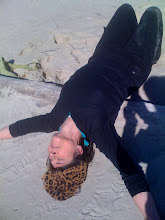
Purpose and Caveats: Rolling like a ball requires us to hold the pelvis in a stable position through an ‘unstable’ motion. It requires keen attention to the details of the movement. You're likely to have an asymmetric roll in the beginning. This will shift as you practice and learn to hold the form with stability. Do not roll if you have osteoporosis or a neck injury, just come into the initial pose and practice holding it for 30 seconds to a minute. (For long time yogis: avoid the tendency to come up to a straight back when you arrive in the balancing position. The focus is different than in navasana: maintain a rounded spine throughout. You'll want to disengage the power centers in the hamstrings and and hip flexors and work from the abs and back instead.)
Focus: Keep your awareness in the sensations of the back of your body as you do this exercise. As the front of the body is curled into itself, let the back of the body be vibrant and awake.
Rolling like a Ball: Come to a seated posture, with your feet on the floor, legs parallel, knees bent, feet on the floor. Catch your hands behind your knees, rock back, lift the feet from the floor and balance on the fleshy area right behind your sitting bones. Tilt your head forward such that your chin is a few inches from your sternum and your gaze is down the front of your body. Engage our abdominal muscles strongly so that your pelvis tilts toward the back of your body, your lower back is rounded and your shoulder blades rotate out to the sides of your body. Tilting your pelvis toward the back of your body will create “the ball” shape you are looking for. Keeping this shape intact throughout the exercise is your goal.
Once you have found your balanced ball-shape it will only take a slight shift in your center of gravity to cause you to roll backwards. Initiate this movement with an exhalation and a deeper tightening of your abs. Roll backward along your spine to your shoulders and then forwards again to come to balance. You should be rocking backing and forth from pelvis to upper back while maintaining the ball shape continuously. Keeping your gaze down the front of your body will help you maintain a healthy and safe neck position throughout the exercise.
Continue to roll 4 to 5 times with your eyes open, then close your eyes and continue for another 4 to 5 rolls with eyes closed. Turn your attention to the back of your body, again and again and again. As you begin to feel confident in your ability to hold the form and stay aligned throughout the exercise try shifting the breathing pattern: inhaling back, exhaling up.
Showing posts with label pelvis. Show all posts
Showing posts with label pelvis. Show all posts
10/10/08
Pelvic Awareness Exercise I: Cat/Cow with a Sandbag
The last post was about the mechanics of the pelvis. This is the first in a series of exercises to bring you into deeper awareness of your pelvis and its mechanics.
Cat/Cow with a sand bag: Come onto a hands and knees position on your mat. Then sit back on your knees, hold a sand bag (or other soft lightly weighted object) on your low back with one hand and then tilt forward onto hands and knees again. You should be positioned with the weight of the sand bag primarily on your pelvis and lower back.
Look for neutral spine: neither flexing upward toward the ceiling nor drooping downward toward the floor. Without moving the pelvis, clearly engage your abdominals muscles to help support the weight of the sandbag.
Once you’ve found the support of your abdominal muscles you can begin to work through spinal flexion (cat) and extension (cow) in time with your breath. With your exhalation lift the sand bag up toward the ceiling by tilting your pelvis backward and arching the lower back upward. On the inhale, keeping your abdominal muscles engaged the whole time, come through neutral spine and gentle tilt the top of your pelvis toward the floor while lifting your head to look forward. Cycle through these two positions in time with your breath for a total of 10 to 20 cycles.
When you’ve finished this exploration come into child’s pose with the sand bag still resting on your low back. To come into child’s pose: bring your big toes to touching and your knees a little wider than hips distance apart. Sit back on your heals and rest your forehead on the floor. You arms may extend out over your head or rest alongside you.
As you continue moving into other yoga poses or even just walking around the house you'll have the ghost of the sandbag on your low back. Use this information to keep awareness there alive. You want to look for standing, sitting, working and living postures that support a graceful neutral spine position: a gentle tilt forward of the top of the pelvis such that the forward lumbar curve is alive, neither drooping toward your belly nor flattened toward your back.
Cat/Cow with a sand bag: Come onto a hands and knees position on your mat. Then sit back on your knees, hold a sand bag (or other soft lightly weighted object) on your low back with one hand and then tilt forward onto hands and knees again. You should be positioned with the weight of the sand bag primarily on your pelvis and lower back.
Look for neutral spine: neither flexing upward toward the ceiling nor drooping downward toward the floor. Without moving the pelvis, clearly engage your abdominals muscles to help support the weight of the sandbag.
Once you’ve found the support of your abdominal muscles you can begin to work through spinal flexion (cat) and extension (cow) in time with your breath. With your exhalation lift the sand bag up toward the ceiling by tilting your pelvis backward and arching the lower back upward. On the inhale, keeping your abdominal muscles engaged the whole time, come through neutral spine and gentle tilt the top of your pelvis toward the floor while lifting your head to look forward. Cycle through these two positions in time with your breath for a total of 10 to 20 cycles.
When you’ve finished this exploration come into child’s pose with the sand bag still resting on your low back. To come into child’s pose: bring your big toes to touching and your knees a little wider than hips distance apart. Sit back on your heals and rest your forehead on the floor. You arms may extend out over your head or rest alongside you.
As you continue moving into other yoga poses or even just walking around the house you'll have the ghost of the sandbag on your low back. Use this information to keep awareness there alive. You want to look for standing, sitting, working and living postures that support a graceful neutral spine position: a gentle tilt forward of the top of the pelvis such that the forward lumbar curve is alive, neither drooping toward your belly nor flattened toward your back.


Subscribe to:
Posts (Atom)